Orinoco Research and Anchorage Digital Host Conference on Economics, Investment and Financial Technology
The “Venezuela: Growth and Development” conference focused the debate on the country’s future on investment and financial reconnection.
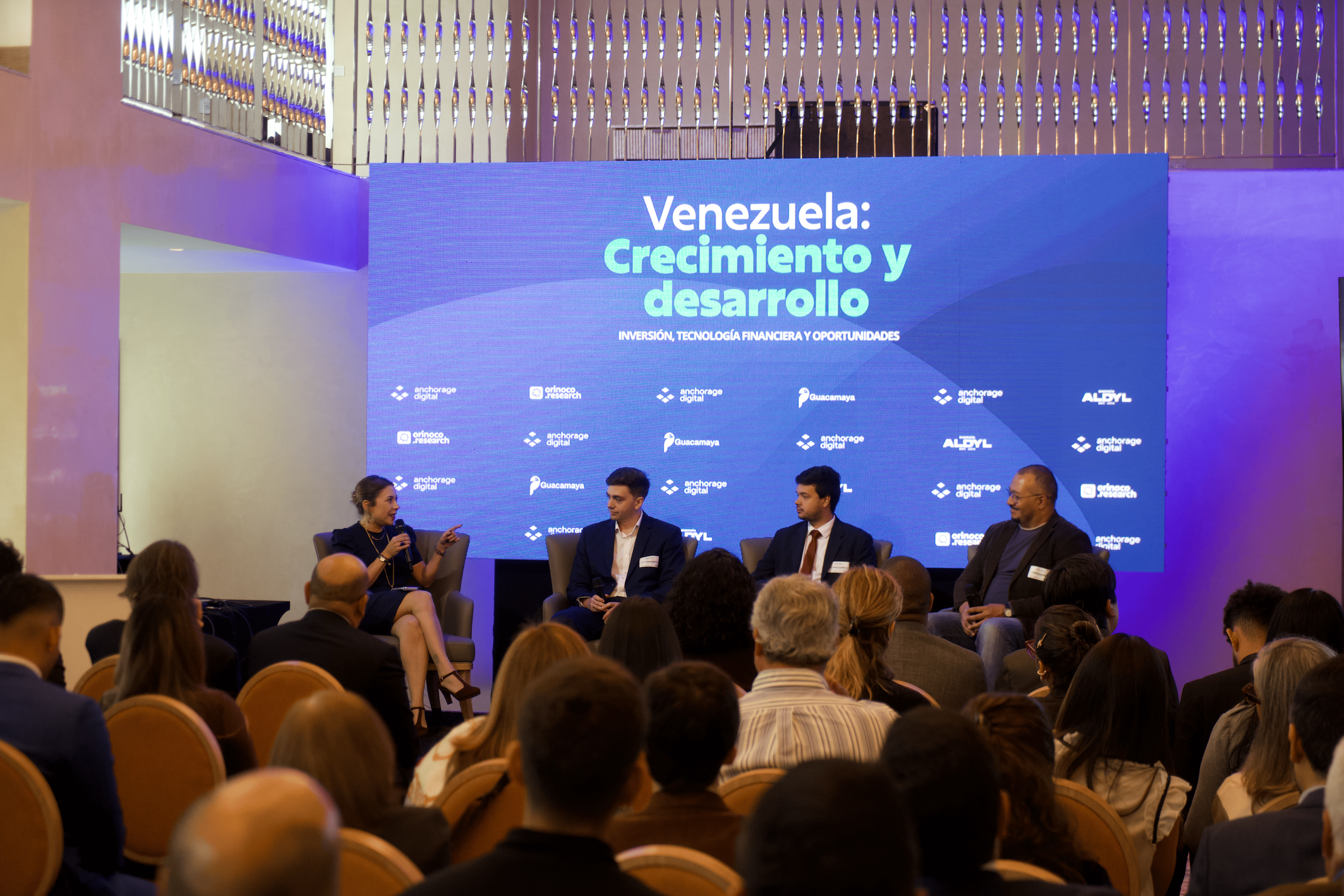
Image: Orinoco Research.
On October 15, Orinoco Research and Anchorage Digital hosted the conference “Venezuela: Growth and Development”. The event was also supported by Aldyl Energía, and counted on the collaboration of the digital outlet Guacamaya, and was hosted at the Hotel Londres in Caracas. The event focused on conditions for attracting investment, expanding access to international financial services and strengthening productive activity.
The program focused on four core areas: the economic outlook through 2027, financial technology and the role of digital assets, the future of state-owned enterprises, and attracting capital in non-oil sectors. The conference drew more than 120 attendees, including business leaders, academics, diplomats and journalists.
The Venezuelan Economy Heading into 2027
The first session, moderated by Blanca Vera, founder of Bitácora Económica, discussed the economic outlook with Manuel Sutherland, professor of Economics at UCV; Fabián Campos, Scenarios Manager at Datanálisis; and Elías Ferrer, director of Orinoco Research and co-founder of Guacamaya.
Fabián Campos described the volatility in public perception. According to Datanálisis data, “in October 2025, 19% of the population thought the country was doing well. By February, it was 50%, and now it is back to 23%.” Campos added that only “14% of the population has the capacity to save, while 86% are in a precarious situation.” He noted that infrastructure, investment and credit will be the determinants of productivity.
Manuel Sutherland, for his part, warned about restrictions on bank credit. “Venezuela has the highest bank reserve requirement in the world at 73%, compared to 26% in Nigeria. Moreover, the Central Bank’s surcharge severely penalizes unmet reserve requirements, which eliminates any possibility of credit,” he stated.
In turn, Elías Ferrer pointed out that “the lack of long-term strategic planning has become a bad habit. We are always putting out one fire after another. There is no team thinking about what will happen over the next five years.” He also stressed the need to assess the real financial strength of the investors entering the market.
Financial Technology in Venezuela’s Reconnection with the World
In a second discussion, Elías Ferrer and Sergio Mello, Director of Digital Asset Infrastructure at Anchorage Digital, spoke in English. Mello stated that “Venezuela’s digital asset inflows were only 45 billion last year, compared to more than 300 billion for Brazil. So there is an order of magnitude to be recovered.”
Mello added that “stablecoins are a gift to humanity, a financial invention as important as smartphones were for everyday life... They are not just a token; they are a treasury instrument, a payment token and a settlement network in themselves.”
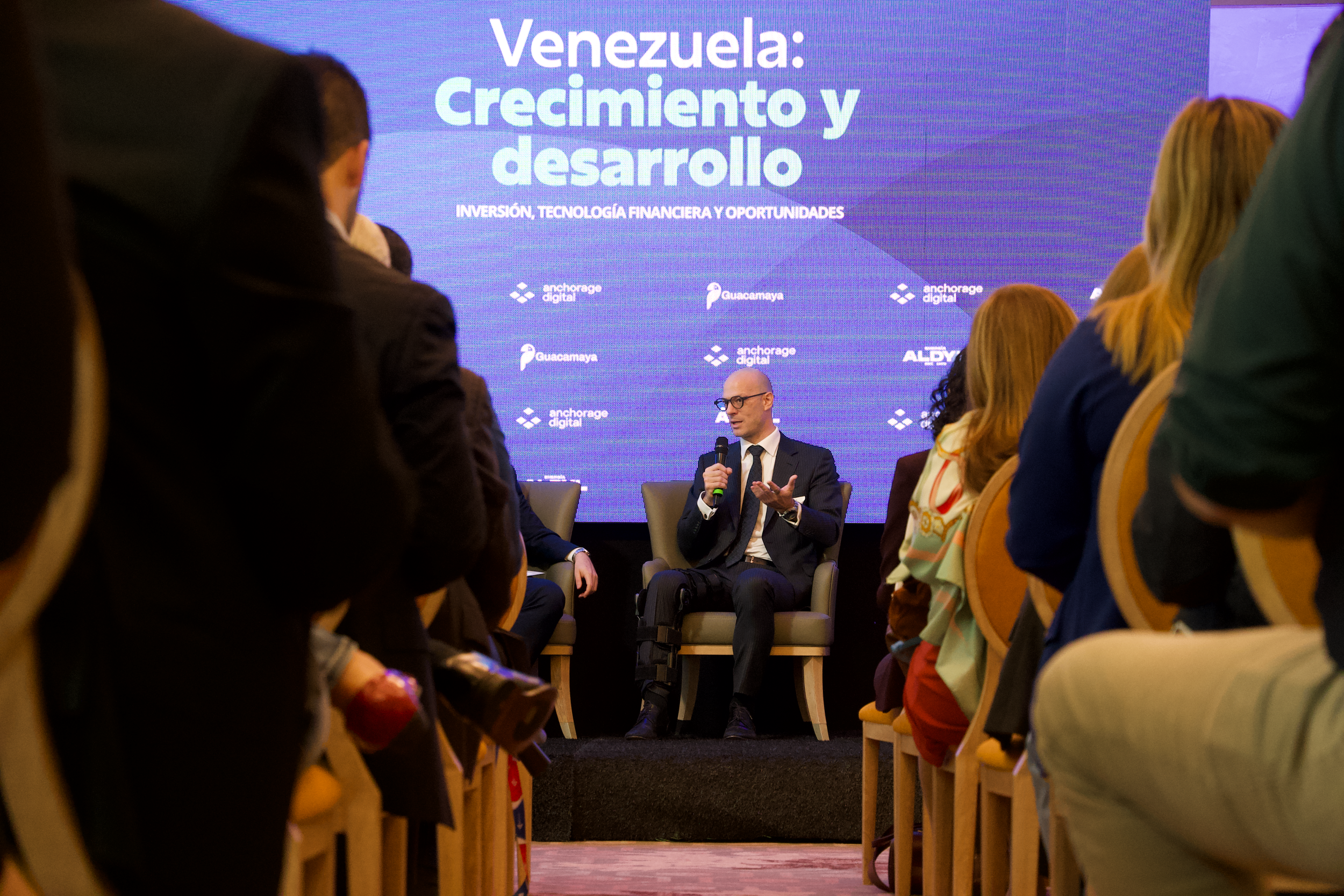
Image: Orinoco Research.
Public Enterprises, Partnerships and Privatisations
The third panel, which opened the afternoon session, was dedicated to public assets and the possibility of privatisation and other models. The panellists were Luigi Pisella, former president of Conindustria and member of the Commission for the Evaluation and Classification of Public Assets; Ricardo Ríos, president of Poder y Estrategia; and Juan Domingo Cordero, president of Rendivalores and of the National Chamber of Securities Market Intermediaries.
Pisella explained that “no company has been sold or returned yet.” Regarding the electricity system, he added that “a law is being drafted for the electricity sector that establishes parameters for joint ventures in which the State retains control but brings in private capital.” He was optimistic, highlighting that “today Venezuela is the most attractive market in the world.”
Ríos presented recent figures on public opinion regarding privatisations, using the electricity sector as an example. “Although 75% of Venezuelans rate electricity service negatively, only 43% fully agree with privatising it, while 35% prefer a mixed model. In addition, 70% would be willing to pay low amounts (up to 10-15 dollars) given their income levels,” he noted.
At the same time, Juan Domingo Cordero underscored the value of the securities market for “democratizing capital.” He added that “the great challenge is a shift in the mindset of Venezuelan business owners toward formality, adapting to international compliance standards and seeking to exit gray lists such as the FATF’s.”
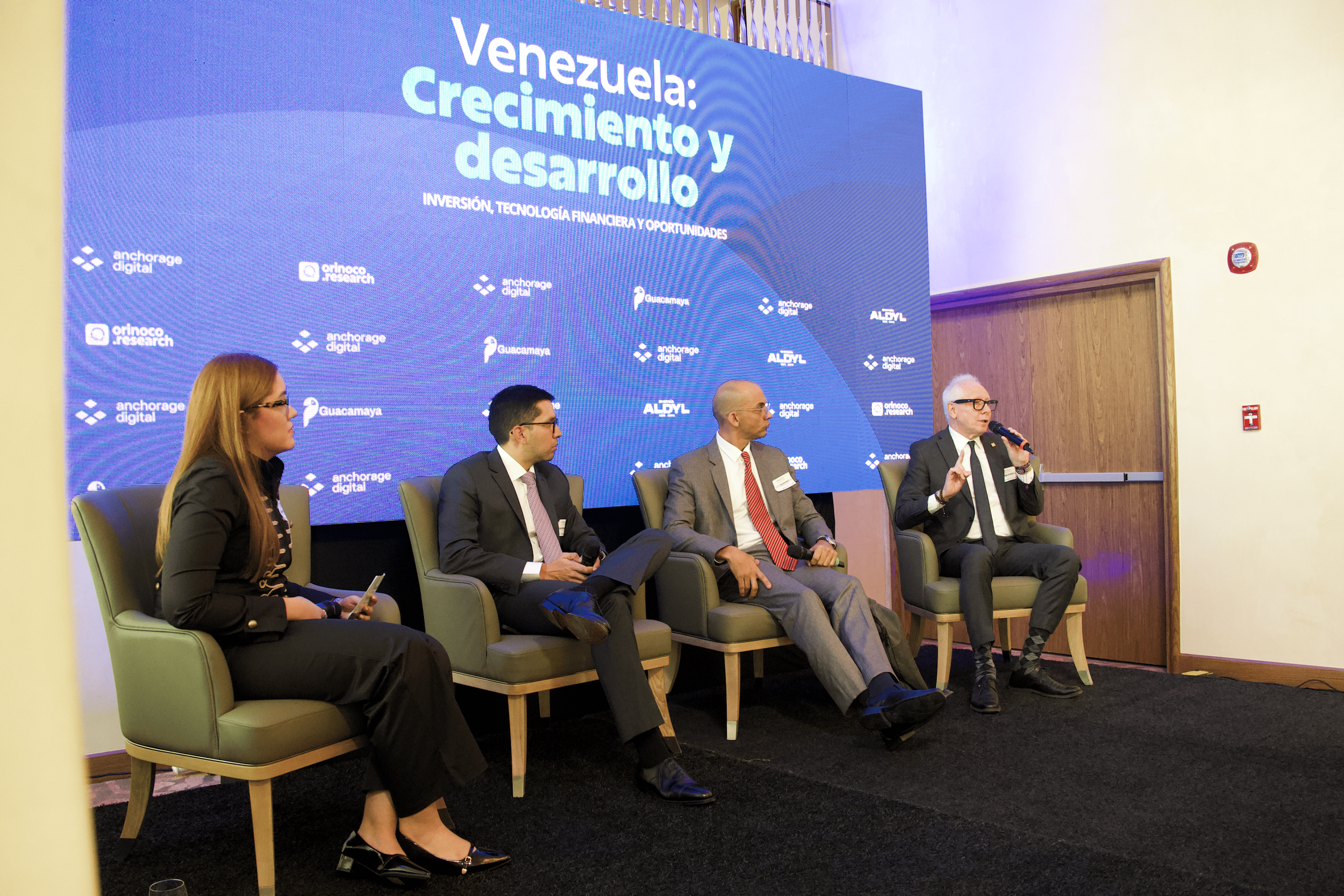
Image: Orinoco Research.
Investment Beyond Oil
The final session was dedicated to non-oil investment, with Tito López, president of Conindustria; Alberto Blohm, managing partner of Solercia Capital and vice president of Conapri; and Rodrigo Naranjo, managing partner of VIPCapital and member of the boards of directors of Conapri and Venecápital.
Conindustria president Tito López stated that “industrial operating capacity is around 51%, and no sector exceeds 70%.” He emphasised that to be competitive, the electricity problem must be fixed first, along with “fiscal voracity,” questioning that between 53% and 63% of profits are paid in taxes, and stressed the need to simplify bureaucratic procedures.
“The credit portfolio is under 4% of GDP (around 4 billion dollars), something a single bank branch in Bogotá handles,” López added.
Rodrigo Naranjo, for his part, warned that “to attract massive investment, the key issue is the Rule of Law.” He also stressed that, in order to make decisions about dollarisation or bimonetarism, the direct experience of business owners in the region should be heard.
Alberto Blohm, meanwhile, pointed to the impact of perceived risk on international valuations. “When explaining to international investors what has changed in Venezuela, the immediate question is: ‘What if we go back to the way things were?’ That raises the required discount rates to levels of 25% or 30%, demanding greater certainty and more time for reforms to consolidate,” he said.